
Introduction
The global battle against pan-drug-resistant “superbugs” has put the biotechnology and pharmaceutical industries under immense pressure. With the antibiotic market set to exceed $8.5 billion annually, the search for new compounds is more than a medical necessity—it’s an industrial frontier.
While over 20,000 antibiotic compounds have been described since the dawn of penicillin, the vast majority share a single, fascinating origin: the Streptomyces genus. Among these, Streptomyces rimosus stands out as the primary producer of Oxytetracycline (OTC), a broad-spectrum antibiotic that has shaped modern medicine and aquaculture for over 50 years.
Why S. rimosus Matters Today
Despite decades of use, tetracyclines remain “drugs of choice” for several high-risk conditions:
-
Malaria and Lyme Disease: Doxycycline (a TC derivative) is the frontline defense.
-
Ulcers: Tetracycline is a key component in triple therapy to eradicate Helicobacter pylori.
-
Bioterrosim Defense: Doxycycline is the primary agent for treating potential anthrax exposure.
-
Non-Infective Breakthroughs: Researchers are now using TCs as inhibitors of angiogenesis (to starve tumors) and as “switches” in advanced gene therapy systems.
The Genetic Blueprint: A Deep Dive
To improve antibiotic yields or create new “hybrid” drugs, scientists have mapped the complex genetics of S. rimosus. Unlike many bacteria, this species has a linear chromosome of approximately 8.6 Mb with a remarkably high G+C content (over 70%).
1. The OTC Gene Cluster
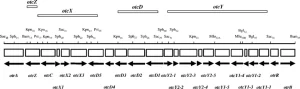
The production of Oxytetracycline is governed by a 30 kb gene cluster on the chromosome, containing 23 open reading frames. This “assembly line” uses a Type II Polyketide Synthase (PKS).
-
The Assembly: The PKS complex iteratively condenses an aminated starter unit (malonamyl-CoA) with eight acetate units to build a C19 backbone.
-
The Tailoring: Once the backbone is formed, specific enzymes (methyltransferases and hydroxylases) modify the structure. For example, the gene otcC encodes a flavin-type hydroxylase essential for the final steps of biosynthesis.
2. The Survival Instinct: Resistance Genes
How does a bacteria produce a lethal antibiotic without killing itself?
- S. rimosus employs three “otr” (Oxytetracycline Resistance) genes:
3. Plasmids and Genetic Instability
S. rimosus often carries large linear plasmids (like pPZG101). These are mobile pieces of DNA that can interact with the main chromosome. Interestingly, som
e overproducing mutant strains (like MV17) were found to have accidentally “copied” the entire OTC gene cluster onto a plasmid, effectively doubling their production capacity through a natural genetic accident.
Engineering the Future – Combinatorial Biosynthesis
The most exciting development in S. rimosus genetics is the move toward “unnatural” natural products. By manipulating the otc biosynthetic genes, scientists are creating new-to-nature compounds.The recent introduction of Tigecycline (a glycylcycline) represents a major victory. It is active against clinical infections like MRSA and vancomycin-resistant Enterococcus that had become completely resistant to traditional tetracyclines.
Streptomyces rimosus is a master of chemical synthesis. By studying its unique linear genome and the modular nature of its polyketide “factory,” we are gaining the tools to stay one step ahead of bacterial resistance. The next generation of antibiotics won’t just be discovered in the soil; they will be engineered in the lab using the genetic logic of this remarkable microbe.