
Introduction
Tigers are among the most endangered species worldwide, with their current population mainly restricted to South and Southeast Asia. Over the past century, three subspecies Caspian, Javan, and Bali tigers have gone extinct, while the remaining subspecies, including Bengal, Amur, Sumatran, South China, Indochinese, and Malayan tigers, continue to face serious threats.
Genetic research has shown that tiger subspecies exhibit low genetic diversity, suggesting limited evolutionary divergence despite geographical separation. Understanding their molecular evolution is essential for conservation strategies. Modern computational biology and DNA barcoding now offer powerful tools to study these evolutionary relationships at the genetic level.
DNA Barcoding and Mitochondrial Markers
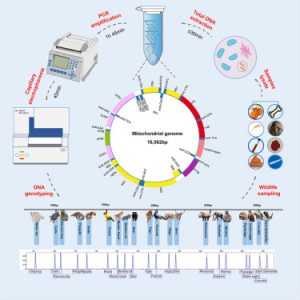
DNA barcoding uses short, standardized DNA sequences to identify species and analyze biodiversity. In animals, mitochondrial DNA (mtDNA) is widely used because of:
- Small genome size
- High mutation rate
- Maternal inheritance
- Strong phylogenetic signal
Among mitochondrial genes, NADH dehydrogenase subunits (ND genes) play a key role in evolutionary studies. These genes are part of the mitochondrial respiratory chain and are essential for energy production through oxidative phosphorylation.
Importance of ND4 in Evolutionary Analysis
The ND4 gene, part of mitochondrial complex I, is highly conserved and functionally critical. It contributes to ATP production by facilitating electron transport. Because of its balance between conservation and variability, ND4 is considered an effective DNA barcode marker.
Key advantages of ND4:
- Helps distinguish closely related species
- Reflects adaptive evolution linked to energy metabolism
- Provides insights into phylogenetic relationships
Mutations in ND4 are also associated with diseases, highlighting its biological importance.
Computational Analysis of Tiger Genetics
Data Collection
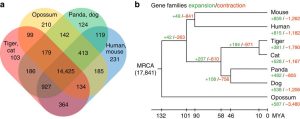
Genetic sequences of ND4 and other ND genes (ND1–ND6) were retrieved from biological databases such as NCBI. These datasets included multiple tiger subspecies and other members of the Panthera genus, such as lions, leopards, and jaguars.
Phylogenetic Analysis
Several computational tools were used to reconstruct evolutionary relationships:
- Multiple sequence alignment ( MUSCLE, MAFFT)
- Phylogenetic tree construction ( PhyML)
- Tree visualization tools (iTOL, TreeDyn)
Different types of phylogenetic trees were generated:
- Rooted trees (showing common ancestry)
- Unrooted trees (showing genetic relationships)
- Cladograms and phylograms
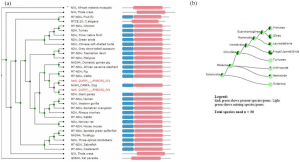
Results showed that tiger subspecies share a common ancestor, with some divergence due to geographic isolation.
Nucleotide Composition and Distribution
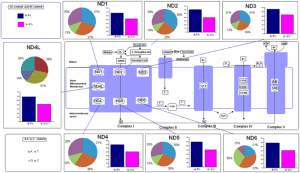
Analysis of mitochondrial ND genes revealed:
- High A+T content, a common feature in mitochondrial genomes
- Low G content, indicating nucleotide bias
- Variations in nucleotide distribution across gene regions
This A+T enrichment is associated with evolutionary adaptation and mutation patterns in mitochondrial DNA.
Molecular Evolution and Conservation
Evolutionary studies identified:
- Conserved regions across ND genes
- Moderate mutation rates in most amino acid positions
- Functional importance of conserved blocks in protein activity
These conserved regions are critical for maintaining energy production and cellular metabolism.
Phylogenomics and ND4 Evolution
Phylogenomic analysis using ND4 across multiple species showed:
- ND4 is present in both vertebrates and invertebrates
- Strong evolutionary conservation across species
- Clear relationships between tiger subspecies and other big cats
This confirms ND4 as a reliable marker for studying evolutionary history.
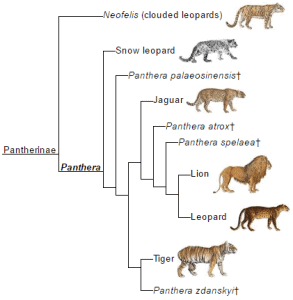
Evolutionary Relationships in the Panthera Genus
Phylogenetic results indicate that:
- Tigers form a distinct genetic group within the Panthera genus
- Tiger subspecies share close genetic relationships
- Lions, leopards, and jaguars diverged from a common ancestor
The Panthera genus is believed to have originated around 11 million years ago, with tiger lineages diverging later.
Divergence Time Estimation
Using molecular clock analysis:
- Tiger lineage divergence is estimated at ~3.5 million years ago
- Panthera species show similar divergence timelines
- Evolutionary separation is influenced by environmental and geographic factors
These findings help reconstruct the evolutionary timeline of big cats.
Implications for Conservation
Understanding tiger genetics has direct applications in conservation:
- Identifying genetic diversity levels
- Tracking population structure
- Designing breeding and protection programs
- Supporting both in situ and ex situ conservation efforts
Low genetic variation highlights the importance of protecting remaining populations to avoid further loss of biodiversity.
Conclusion
This study demonstrates that ND4 and other mitochondrial genes are powerful tools for analyzing tiger evolution. Through DNA barcoding and computational biology, researchers can better understand genetic relationships, evolutionary history, and adaptive mechanisms in tiger populations.
These insights are essential for developing effective conservation strategies and ensuring the survival of this iconic species in the wild.