
Introduction to Tetracycline Antibiotics
Tetracyclines (TCs) are a major class of polyketide antibiotics widely used in clinical medicine due to their broad-spectrum antibacterial activity. Important members include oxytetracycline (OTC) and chlortetracycline (CTC), which have been used since the 1940s to treat infections caused by:
- Gram-positive and Gram-negative bacteria
- Mycoplasmas
- Chlamydiae
- Rickettsiae
- Protozoan parasites
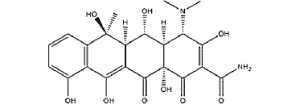
Structurally, tetracyclines consist of four fused six-membered carbon rings, forming a rigid core with multiple functional groups. Their biological activity depends strongly on specific structural regions:
- Lower peripheral region (C10–C4a): essential for ribosome binding
- Upper peripheral region (C7–C9): allows chemical modifications to improve activity
Changes in the lower region usually reduce antibiotic activity, while modifications in the upper region can enhance antimicrobial properties.
Historical Development of Tetracyclines
The first tetracyclines were discovered in the mid-20th century:
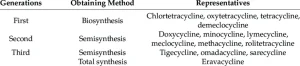
- Chlortetracycline (CTC) : isolated from Streptomyces aureofaciens
- Oxytetracycline (OTC) : produced by Streptomyces rimosus
These discoveries marked the introduction of the first broad-spectrum antibiotics.
Later developments led to:
- Natural tetracyclines (tetracycline)
- Industrial intermediates like demeclocycline (6DM-CTC)
- Semisynthetic derivatives with improved properties
Tetracyclines remain widely used today, with drugs like doxycycline maintaining a significant global market.
Mechanism of Action
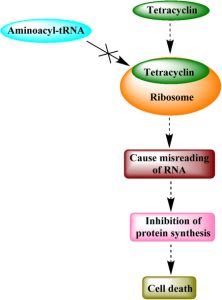
Tetracyclines act by inhibiting protein synthesis in bacteria. They bind to the 30S ribosomal subunit, preventing the attachment of aminoacyl-tRNA to the ribosome.
This results in:
Second-Generation Tetracyclines
To improve pharmacological properties, semisynthetic modifications were developed:
- Doxycycline: improved stability, bioavailability, and therapeutic efficacy
- Minocycline: enhanced ribosomal binding and broader antibacterial activity
These drugs are widely used to treat:
- Respiratory infections
- Acne
- Sexually transmitted infections
- Malaria (prophylaxis and treatment)
Third-Generation Tetracyclines
Due to increasing antibiotic resistance, new derivatives were developed:
- Tigecycline: a glycylcycline with high ribosome affinity
- Effective against resistant pathogens such as:
- MRSA
- Vancomycin-resistant enterococci
- Drug-resistant Streptococcus pneumoniae
Tigecycline represents a major advancement in overcoming resistance mechanisms like:
- Efflux pumps
- Ribosomal protection proteins
New Tetracyclines in Development
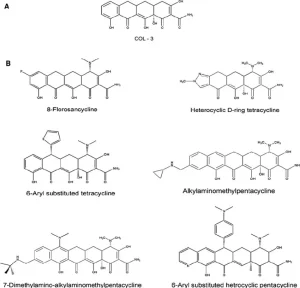
Recent innovations include:
- Omadacycline: improved oral availability and activity against resistant strains
- Eravacycline: highly potent with strong ribosomal binding
These compounds are designed to expand treatment options against multidrug-resistant bacteria.
Atypical Tetracyclines
Tetracyclines can be divided into two groups:
Typical Tetracyclines
- Inhibit protein synthesis
- Bacteriostatic
Atypical Tetracyclines
- Do not primarily target ribosomes
- Likely disrupt bacterial membranes
- Exhibit bactericidal effects
Examples include:
- Chelocardin
- Anhydrotetracycline
These compounds represent promising alternatives for future antibiotic development.
Biosynthesis of Oxytetracycline
The biosynthesis of oxytetracycline in Streptomyces rimosus is one of the most extensively studied antibiotic pathways.
Gene Cluster Organization
The OTC biosynthetic gene cluster contains genes encoding enzymes responsible for:
- Polyketide backbone formation
- Cyclization and aromatization
- Functional group modifications
- Regulation and resistance
This cluster is approximately 35 kb in size and functions as a coordinated unit.
Formation of the Tetracycline Backbone
The tetracycline core is synthesized by a Type II polyketide synthase (PKS) system, composed of:
- Ketosynthase α (KSα)
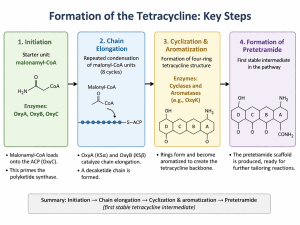
- Ketosynthase β (KSβ)
- Acyl carrier protein (ACP)
Steps include:
- Initiation
- Starter unit: likely malonamyl-CoA
- Enzymes: OxyA, OxyB, OxyC
- Chain elongation
- Repeated condensation of malonyl-CoA units
- Cyclization and aromatization
- Formation of four-ring tetracycline structure
- Enzymes: cyclases and aromatases ( OxyK)
- Formation of pretetramide
- First stable intermediate in the pathway
Tailoring Reactions
After backbone formation, multiple enzymatic modifications occur:
- Methylation (C6) :OxyF
- Hydroxylation (C4, C12a) :OxyL and OxyE
- Amination (C4) : OxyQ
- Dimethylation : OxyT
- Additional hydroxylations (C5, C6) : OxyS
- Final reduction step : OxyR
These steps produce the final active compound: oxytetracycline.
Regulation of Biosynthesis
OTC production is influenced by:
- Nutrient availability (carbon, nitrogen, phosphate)
- Environmental conditions (pH, oxygen levels)
Key regulatory proteins include:
- OtcR: pathway-specific activator
- OtcG: modulates production levels
Low phosphate conditions are known to enhance antibiotic production.
Resistance Mechanisms
Streptomyces rimosus contains self-resistance genes:
- otrA: protects ribosomes
- otrB: efflux pump removing antibiotic
- otrC: additional resistance function
These mechanisms are similar to resistance genes found in pathogenic bacteria.
Future Directions in Tetracycline Development
Biosynthetic Engineering
Modern approaches aim to modify biosynthetic pathways to create new antibiotics:
- Engineering starter units
- Modifying post-PKS tailoring enzymes
- Combining gene clusters from different organisms
Synthetic Biology and Genomics
Advances in:
- DNA sequencing
- Gene editing
- Metabolic engineering
are enabling the discovery of new tetracycline analogues.
Novel Compounds
New tetracycline-like molecules are being explored from microbial sources, offering:
- Improved activity
- Reduced resistance
- New mechanisms of action
Challenges and Opportunities
Despite progress, challenges remain:
- Limited diversity from biosynthetic pathways
- Complexity of genetic manipulation
- Rising antibiotic resistance
However, emerging technologies are expected to accelerate the development of next-generation tetracycline antibiotics.
Conclusion
The biosynthesis of oxytetracycline in Streptomyces rimosus represents a highly complex and well-coordinated process involving polyketide synthesis, enzymatic tailoring, and regulatory control. Tetracyclines remain essential antibiotics, but resistance has driven the need for new derivatives.
Future advances in biosynthetic engineering and synthetic biology will play a critical role in developing novel tetracycline-based therapeutics, ensuring their continued relevance in modern medicine.