

Introduction to Nanotechnology
Nanotechnology refers to the control and manipulation of materials at the nanoscale, typically between 1 and 100 nanometers (nm). At this scale, materials exhibit unique physical and chemical properties due to a significantly increased surface area-to-volume ratio.
These nanoscale properties can differ greatly from bulk materials, enabling innovative applications. For example:
- Copper can become transparent
- Platinum can act as a strong catalyst
- Aluminum may become highly reactive
- Gold nanoparticles can behave like liquids at room temperature
- Silicon can shift from insulating to conductive behavior
Nanomaterials are already used in various industries, including:
- Titanium dioxide in sunscreens
- Silver nanoparticles in food packaging and disinfectants
- Zinc oxide in cosmetics and coatings
These properties make nanotechnology highly promising for biomedical applications, especially in cancer detection and treatment.
Understanding Cancer
Cancer is a disease caused by genetic mutations that disrupt normal cell growth and division. These mutations affect genes responsible for regulating essential cellular functions.
Cancer cells require a blood supply to grow, which they achieve through angiogenesis (formation of new blood vessels). Treatment strategies typically focus on:
- Correcting genetic damage
- Blocking blood supply
- Destroying cancer cells
Early detection is critical, as conventional methods often identify cancer only after significant tumor growth.
Why Nanotechnology is Important in Cancer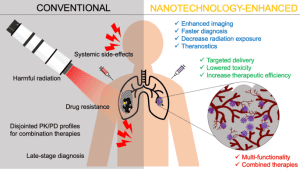
Nanoparticles (NPs) are small enough to interact directly with cellular and molecular components. For reference:
- DNA diameter ≈ 2 nm
- Bacteria ≈ 200 nm
- Human cells ≈ micrometers
This size advantage allows nanoparticles to:
- Enter cells
- Interact with DNA and proteins
- Detect early molecular changes
Nanotechnology aims to develop multifunctional systems capable of:
- Detecting cancer
- Delivering targeted therapy
- Monitoring treatment effectiveness
Cancer Detection: Conventional vs Nanotechnology
Conventional Methods
Traditional cancer detection includes:
- X-rays and CT scans
- Biopsy and cell culture
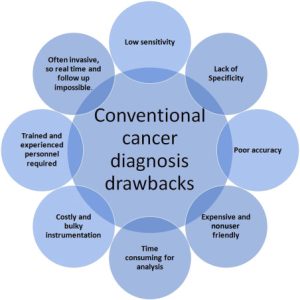
Limitations:
- Low sensitivity
- Detection at advanced stages
- Reduced treatment success
Nanotechnology-Based Detection
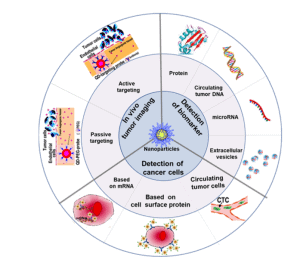
Nanoparticles enable early-stage detection by:
- Entering cells and interacting with DNA
- Identifying genetic mutations at initial stages
- Supporting both in vivo and in vitro diagnostics
This approach significantly improves early diagnosis and precision medicine.
Cancer Treatment Approaches
Conventional Treatments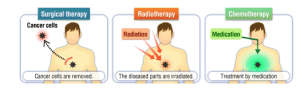
- Surgery
- Removes tumor tissue
- Limitations: organ loss, recurrence risk
- Radiation Therapy
- Destroys cancer cells using radiation
- Limitations: damages healthy tissue
- Chemotherapy
- Uses toxic drugs to kill rapidly dividing cells
- Limitations: non-specific, affects healthy cells
Nanotechnology-Based Treatment
Nanotechnology introduces targeted therapy, reducing damage to healthy cells.
Key strategies include:
- Nanoparticles designed to absorb specific radiation wavelengths and generate heat to destroy cancer cells
- Targeted drug delivery systems that release therapeutic agents directly into tumor cells
- Controlled and time-release drug mechanisms
Nanoparticles can:
- Circulate in the body
- Detect cancer biomarkers
- Assist in imaging
- Deliver drugs
- Monitor treatment response
Nanotechnology Tools in Cancer Therapy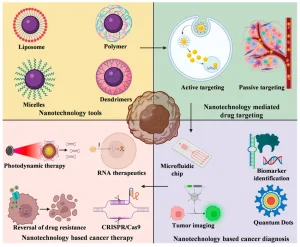
1. Cantilevers
Micro-scale sensors that detect cancer molecules by bending when binding occurs, enabling early diagnosis.
2. Nanopores
Allow DNA strands to pass through for rapid sequencing, helping identify genetic mutations linked to cancer.
3. Nanotubes
Enable high-resolution mapping of DNA structure to locate mutations precisely.
4. Quantum Dots
Fluorescent nanoparticles used for imaging and labeling cancer cells with high sensitivity and multiplexing capability.
5. Nanoshells
Gold-coated nanoparticles that absorb near-infrared light and generate heat to selectively destroy tumor cells.
6. Dendrimers
Highly branched nanoparticles used for:
- Targeted drug delivery
- Cancer cell recognition
- Monitoring therapeutic outcomes
Challenges in Nanotechnology for Cancer
Despite its potential, several challenges remain:
- Toxicity risks due to high reactivity and ROS (reactive oxygen species) generation
- Rapid clearance from the body, reducing effectiveness
- Accumulation in organs, leading to possible side effects
- Complex interactions with biological systems
Each nanomaterial must be evaluated individually based on:
- Size
- Shape
- Surface properties
- Chemical composition
Health and Environmental Concerns
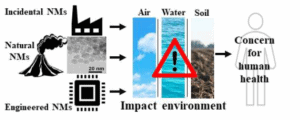
Nanoparticles can:
- Penetrate biological membranes
- Enter the bloodstream via inhalation, ingestion
- Reach organs such as the brain, liver, and kidneys
Potential risks include:
- Oxidative stress
- Inflammation
- DNA damage
- Cellular toxicity
These effects are mainly linked to the production of reactive oxygen species (ROS).
Regulatory Considerations
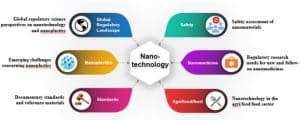
Current regulations often do not distinguish between bulk materials and nanoscale materials, which creates safety gaps.
Recommendations include:
- Treat nanomaterials as potentially hazardous
- Conduct specific safety and toxicity testing
- Limit environmental exposure
Global regulatory frameworks are still evolving to address these challenges.
Recent Advances
- Carbon nanotubes show unique properties but may have toxicity concerns
- Quantum dot-based systems enable real-time imaging and drug delivery tracking
- Nanoparticle-based gene therapy (siRNA delivery) shows promising results in targeted cancer treatment
Conclusion
Nanotechnology offers significant potential in early cancer detection and targeted therapy. Its ability to interact at the molecular level allows for more precise and effective treatment strategies.
However, challenges related to toxicity, safety, and regulation must be addressed before widespread clinical application.
Future research will focus on improving:
- Biocompatibility
- Targeting accuracy
- Clinical safety
Nanotechnology is expected to play a major role in the future of personalized cancer medicine.